Stereoscopic digital photography
Stereoscopic photography is not new. Photographers have been creating 3D images using this technique as long as cameras have been around (have a look at the history of photography and digital photography here).On these pages you will find information on how stereoscopic photography works.
There's also lots of tips and tricks on how to achieve the effect with digital photography (it's far easier with digital photography than traditional photography), plus a "trainer" image.
It's quite common for people to struggle to view these images - especially at first. This trainer image and viewing tips and tricks will help.
If, after reading through the pages on stereoscopic photography here, you'd like to have a go at 3D digital photography yourself, have a look at how to make a 3D photo.
|
Want even more photography tips and tricks? Subscribe to my monthly newsletter, "Stay Focussed" and get even more digital photography tips. Go to the Stay Focussed newsletter signup page |
These pages on 3D digital photography, and digital-photography-tips.net itself, are updated regularly. To learn out about the updates as they happen click here to subscribe to the digital photography blog, and this site's RSS feed.
So how does 3D digital photography work?
Stereoscopic vision works on a basic principle - the fact that we have two eyes that are a few inches apart.This means that when we look at anything the image seen by the right eye is slightly different from what we see from the left eye.
Have a look at the diagram below to see how this works:
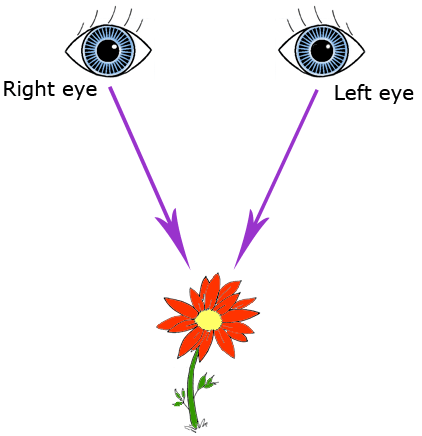
The separation of our eyes creates a triangle between the thing you're looking at and your two eyes. With this your brain calculates the distance of objects within the scene. This gives us our 3D vision.
As a test to see how well this works, cover one eye and then reach for something on your desk. Do it now!
Weird feeling, isn't it?!
With one eye closed off your brain is unable to "triangulate" the exact distance of objects. As your hand goes to grab that object you have to stop and really think. Your stereoscopic vision is gone.
The brain can adapt
You will still be able to grab that object, because your brain will fall back on its experience to help you out. It just takes a little longer, and means you have to think a little harder to do it.Ok, you can uncover your eye now!
. . . and there's more . . .
In the diagram above the left eye and right eye form a triangle on the flower. This means the brain can work out the distance to the object. If you reach for the flower, you brain can tell you how far to reach.But there's more to stereoscopic photography, and our own stereo vision, than simply distance.
Go back to the diagram above. The left eye and right eye also view different sides of the flower. Follow the arrows and you will see that some parts of the flower can only be seen by the right eye, and some parts only by the left.
It's this extra piece of information that creates a true 3D effect. Your brain will take in the information from the left eye, combine it with information from the right eye, and then piece all of that together to form a true 3D picture.
How is it done in digital photography?
For stereoscopic photography to work what we have to do is recreate the two images that would have been seen by the left eye, and the right eye. This means taking two almost identical pictures.In simple terms, one photo of a scene is taken by focusing the camera through the right eye. Then the photographer moves the camera to their left eye and retakes the scene. They now have two pictures, one taken "through" the right eye, and one "through" the left eye.
You then view these two images side by side. It does take a little work by the brain to piece them together again. It's odd at first, but your brain can be trained!
That's the theory behind stereoscopic photography. To produce 3D photographs yourself, you will need a little more guidance. All you need is right here on these pages though! So, delve in, and have a go at 3D stereoscopic digital photography!
- Further reading:
- History of photography and digital photography
- Stereoscopic trainer image and viewing tips and tricks
- How to make 3D digital photos
- Stay Focussed - FREE newsletter.
|
Photo Gallery! |
My son (that's him below) loves F1. He's started his own YouTube channel and would love it if you could take a look at one or two of his videos.
Or, if it hurts your ears as much as it does mine, pass the link on to someone who'll really appreciate it.
Or, if it hurts your ears as much as it does mine, pass the link on to someone who'll really appreciate it.
(probably someone a lot younger than I am!)
 Get help using your camera with the complete Digital SLR Guide |