Terrific digital photography printing is achievable!
Digital photography printing seems like a mystery sometimes.
Many people use software like Photoshop to edit images, but then don't properly prepare images for printing.
Worse, the printer and paper are often not set up correctly. The result? Disappointing pictures.
A proper set up is possible and should result in photos to be proud of. Banish those disappointing prints right now!
What end result did you have in mind?
Before you print anything though, think carefully about why you want to print your own pictures.If you want to print:
- Standard print sizes - snaps or standard size enlargements.
- Black and white prints - of any size . . .
. . . then choose a good print service that prints onto proper photographic paper. They will produce a better quality, more durable and cheaper print than you can. After all, their printers cost $000s - yours probably doesn't!
I don't want to completely put you off printing your own photographs, it's just that from experience I have found it far easier and cheaper to get someone else to do the job for you.
The initial investment . . .
In order to get top quality digital photography prints from home you will need quite some investment:- A decent printer
- Manufacturers own inks
- Special paper
- Time and patience!
Read on to see why this investment is needed.
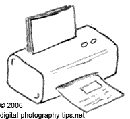 A decent printer is a photo printer with at least six colours. There are cheaper "photo" printers available that use only three colours + black. These are not really designed for printing digital photographs. They cannot produce the wide range of colours needed for a good print. You can read more about why
here
.
A decent printer is a photo printer with at least six colours. There are cheaper "photo" printers available that use only three colours + black. These are not really designed for printing digital photographs. They cannot produce the wide range of colours needed for a good print. You can read more about why
here
.
. . . and the running costs . . .
 Manufacturers' own inks are needed to get the best results. Manufacturers invest heavily in ensuring their inks produce top quality digital photography printing. With the high levels of investment they aren't going to let their ink formulas leak into the hands of third party manufacturers!
 The downside is cost. It is possible to get very good prints from third party ink manufacturers, and far cheaper. But it will never be the very best quality.
. . . more running costs . . .
Special paper. Normal printer paper is quite absorbent. Ink tends to bleed slightly onto it. This results is feathered edges in your picture where some parts of the image merge into others.To get the best digital photography printing you have to minimise the feathering. The only way is to buy more expensive photo papers. These are usually plastic coated. This stops the ink bleeding and results in a much more crisp digital photography print.
Patience! Yep, you'll need plenty of this for printing at home believe me! You print out a lovely digital photograph and . . . colour cast? Paper round the wrong way? More green and white than black and white? Too small? Too big? . . . the list could go on and on!
What's it all worth?
On top of all this is the cost. Digital photography printing at home is costly.A standard size photo, printed at home, will cost between 50c to $1.50. That pays for the ink and paper.
For all of the reasons outlined on this page I would seriously recommend using a print service.
If you decide to take my advice and use a professional digital photography printing or an online printing service it will be worth spending a few minutes to look at how to properly prepare images for printing.
The print service you choose will be able to deliver better prints to you if you can provide them with a good quality starting image. I've used Photoshop as an example, but the same advice applies for any image editing software.
If you really must
If, despite all this, you still want to print your photos at home then have a look at digital photography printing - resolution explained. I've explained why resolution is an important first step.If you want to dive straight into digital photography printing then have a look at top quality digital photography printing at home for more detailed help and advice.
It would also be worth you having a look at my page on the correct printer setup to make sure you set your printer up properly before you start your digital photography printing. It will help save you some money in ink and paper and save you some time.
As a final thought, you might want to go mad and check your monitor calibration. It won't seriously affect your printing, but is worth a little look anyway.
My son (that's him below) loves F1. He's started his own YouTube channel and would love it if you could take a look at one or two of his videos.
Or, if it hurts your ears as much as it does mine, pass the link on to someone who'll really appreciate it.
Or, if it hurts your ears as much as it does mine, pass the link on to someone who'll really appreciate it.
(probably someone a lot younger than I am!)
 Get help using your camera with the complete Digital SLR Guide |