Flower photography -
capture the wider scene for great flower photos
Flower photography should be so simple - with all those colours, what could go wrong?
Sometimes however, despite our best efforts, flower pictures can lack a little punch.
Here I show you how to get a really good flower pictures by using a simple technique - looking beyond the flower in front of you and taking in the wider scene.
And when you've finished here, have a look at my photographing flowers home page for even more tips.
Flower photography - assessing the scene
A useful tip to get great flower photographs is to have a look at the whole scene around the flowers.The photo below is the one I will use as an example here.
It neatly demonstrates how encompassing the whole scene can make a dramatic difference to your flower photos.
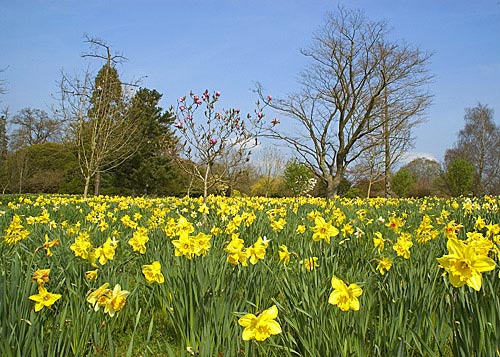
So what are the photography secrets in this photo that makes it a good shot?
The big thing is the wide shooting angle.
Instead of taking a photo of just one bloom, or a bunch of blooms, I deliberately chose a really wide angle in order to get the background in shot too.
I also made sure I got down fairly low, almost to flower level. This gives a greater sense of a field of flowers stretching into the distance.
But don't just take the scene without a little thought!
Look into the background - is there something distracting that would be better left out? A car? An ugly building?
Before you press the shutter button look for any of these distractions, and if they are there, re-frame your photo so that they are either out of shot or hidden behind something of genuine interest.
Flower photography - Camera settings
For this type of wide angle photo it is important to check one camera setting in particular - the aperture.The aperture helps control how much light enters the lens, and also controls completely the depth of field.
For this photo I wanted to get everything in focus, from the flowers in the foreground right up to the trees in the background.
To do this you need to set the aperture on your camera to its highest number (the number will usually be preceded by the letter f, and the numbers are called f-stops)
Click to find out more about depth of field.
Flower photography - Post processing
To really make your flower photos stand out from the crowd you will need a little post processing.In the photo above I used Photoshop to do the following:
- First - crop the photo if it needs it. Click to read a digital photography tutorial on using the crop tool.
- Then boost the contrast setting a little (this will make the colours appear more saturated)
- Boost the saturation (if the colours are still a little weak)
- Sharpen the photo (look for a sharpening setting - use your software's 'help' function to find it - it will be there somewhere!)
Now have a look at my flower photography home page for even more photography tips and tricks!
My son (that's him below) loves F1. He's started his own YouTube channel and would love it if you could take a look at one or two of his videos.
Or, if it hurts your ears as much as it does mine, pass the link on to someone who'll really appreciate it.
Or, if it hurts your ears as much as it does mine, pass the link on to someone who'll really appreciate it.
(probably someone a lot younger than I am!)
 Get help using your camera with the complete Digital SLR Guide |